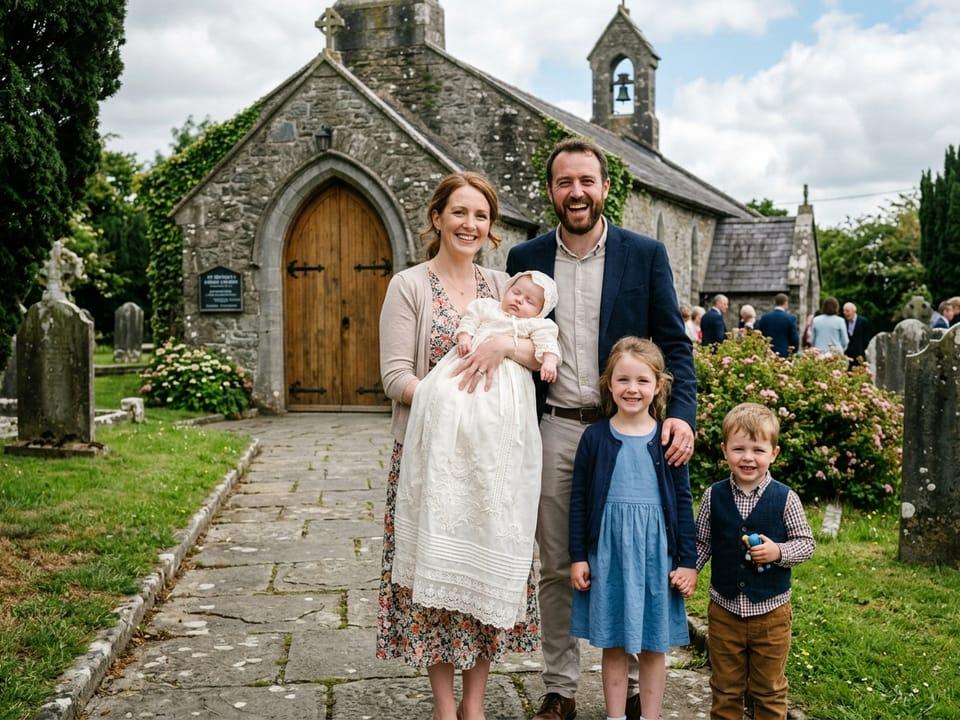
Plan the day backwards from the time the parish gives you. Shift the morning nap so your baby wakes before you leave, feed about 20 minutes before the ceremony, and put the gown on last. A cry when the water is poured lasts seconds and is part of the day. The stretch worth protecting is the ten minutes of photos straight afterwards, so build in a feed and a nappy change between the final blessing and the group shots, and ask the parish whether other families share your slot, because waiting is the part you can't control.
Get the real start time, not just the Sunday
In many Irish parishes, baptisms happen on set Sundays, and the slot often lands in the early afternoon, right on top of a nap and a feed. Halston Street parish in Dublin, for example, holds baptisms only on the second and third Sundays of the month, following the 12 noon Mass. St Agnes' parish in Crumlin baptises on the second and fourth Sundays at 1:30pm, after a preparation meeting on the first Wednesday of the month.
A baptism that follows Mass starts when Mass ends, not at a fixed minute, so ask the parish office what time to arrive and where to wait. Ask too whether other babies are being baptised in the same ceremony. A shared slot means more names, more families at the font and more photos queued afterwards, and you'll want a plan for that extra half hour rather than a hungry baby in a lace gown.
Move the morning nap, not the afternoon one
The HSE's guide to naps gives the shape to plan around. Babies nap for three to four hours a day in total. At two months, babies take around four naps; up to three months there may be one to two hours between naps, and from three to six months about two to two and a half hours. Between six and nine months they usually drop to two naps, and at 12 to 15 months to one nap in the middle of the day.
So the trick is to time the last nap before the ceremony so it ends shortly before you leave the house. A young baby who wakes at 11:30 is at their best for an early-afternoon start; an older baby who usually naps at midday will need that nap earlier, or a buggy nap on the way to lunch afterwards. The HSE also suggests letting a child wake naturally, as they're in a better mood. Don't wake a sleeping baby in the car park unless the priest is waiting.
Here's how that looks for three common slots:
- After a morning Mass (around 11am): early feed at home, a short nap in the car, top-up feed at the church, then the long nap in the car to lunch.
- After the noon Mass (roughly 12:45 to 1pm, depending on how long Mass runs): morning nap from about 10:30, feed at home before leaving, gown on at the church door.
- A fixed 1:30pm slot: nap late morning, feed in a quiet corner at about 1:10, nappy change, gown on, in your seat by 1:25.
Feed 20 minutes before, and put the gown on last
A baby who has just fed is heavier, warmer and calmer. Feed in the car or a side room about 20 minutes before the start, wind them, change the nappy, and only then put the gown on. Keep a muslin over it until the last moment. Take the coat and hat off once you're inside; the HSE's nap advice is to remove shoes and outer clothing so children don't overheat, and a church packed with relatives warms up fast.
Pack a second feed. If a bottle is ready, or the parent who breastfeeds has a cardigan and a quiet seat at the side, you can settle a hungry baby before the photos without anyone rushing.
The water takes seconds; protect the ten minutes after
The rite has a set order. The Catechism describes the sign of the cross at the threshold, the Word of God, a prayer of exorcism with anointing, the blessing of the water, then the baptism itself, with water poured three times over the head. After that come anointing with chrism, the white garment, a candle lit from the Easter candle and the final blessing. The water comes past the middle, and most of the ceremony is spent being held, which is the best time for a calm baby.
Let whoever settles the baby best hold them at the font, even if the plan was for a godparent. Afterwards, photograph the parents and baby first while everyone is fresh, then the godparents, then grandparents, and leave the big group for last; the christening photo ideas guide has an order that works. If your baby is hungry, feed first. Ten calm minutes after a feed beat twenty anxious ones before it.
Who takes the photos: photographer, studio or family
A photographer at the church costs the most, but they keep shooting while you deal with feeds, and they can marshal a big group of relatives quickly. That matters when grandparents have travelled or there are several families in one slot. Photography during the rite itself is up to the parish, so check what's allowed first (christening photography rules). A studio session on another day lets you book your baby's best hour, with no Mass times to fit around, though it won't capture the font or the candle. Family on phones cost nothing and bend around any nap, and they suit small christenings well; give one person the job so they aren't also holding the baby.
If the photos still don't happen, make one at home
Sometimes the baby sleeps through the whole group shot, or cries through it, and that's fine. pokesta can make a christening family portrait with AI from phone photos you already have, with the gown, the candle and the church; it's $1 per photo, and the first one is free. It is a made image rather than a record of the ceremony, so keep it alongside the real photos, not instead of them. Try it with a recent, well-lit photo of your baby and create the free first photo before you decide whether to book a studio session.
References