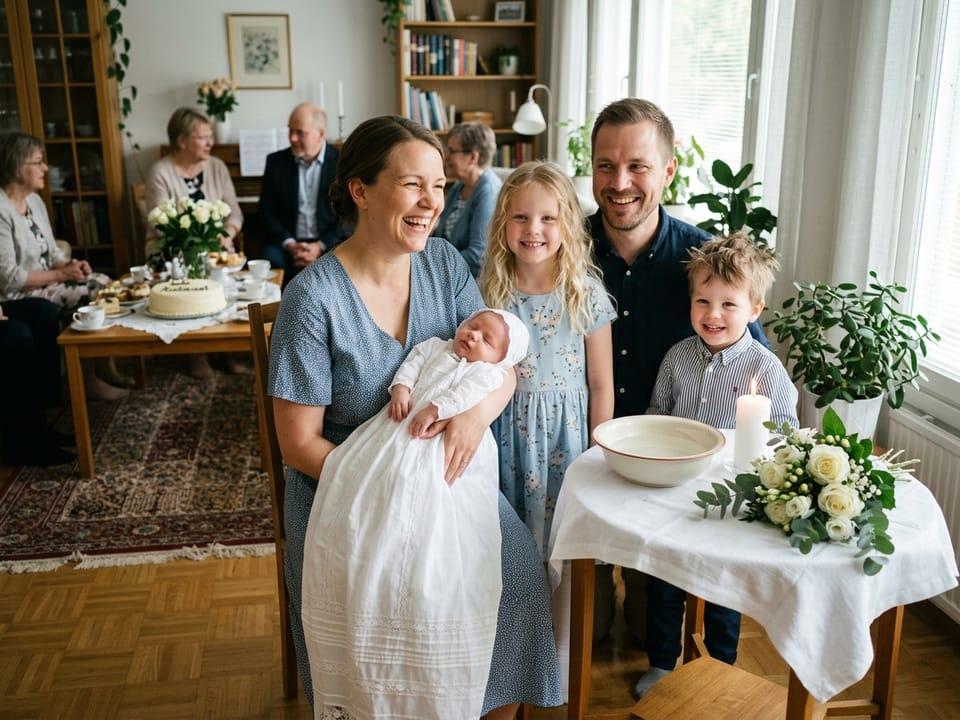
Start by asking your parish. The Evangelical Lutheran Church of Finland suggests that families without a gown ask their parish for a loan one, and parishes such as those in Kuopio keep christening gowns to lend; you ask when you book the christening. If your parish has none, second-hand is the cheapest route: on Tori.fi in late October 2026, most kastemekko listings were asking between about 10 and 80 euros. Buy new only if you mean the gown to be handed down, and remember that a gown isn't required at all.
A gown is a custom, not a requirement
The white christening gown, the kastemekko, has become the established outfit for a Finnish baby's christening (ristiäiset). White stands for joy, gratitude and purity. The long white gown is nearly 200 years old as a tradition; in the 1830s hems grew to as much as a meter. Families have long embroidered the names of every child baptized in a gown, or initials and the date on the hem, so an heirloom gown carries the family's history. Borrowing is old, too: Finnish Wikipedia notes that lending gowns has a long tradition among families with less money, and in earlier centuries a midwife or the parsonage might lend one.
Still, the church is clear that a gown is not a necessity. A baby can just as well be baptized in their own clothes. In Kuopio's parishes, older children and adults are given a white alb instead.
Size matters more than you might think. Most Finnish babies are baptized within two to three months of birth, and babies grow quickly in those weeks. Gowns on second-hand sites come in sizes like 56, 62 and 68, or simply "one size" for the long, loose styles.
Four ways to get one, side by side
|
Cost (as of October 2026) |
Effort |
In photos |
Watch out for |
| Parish loan |
Ask the parish; terms vary |
Pick up and return |
Classic long white gown |
Limited sizes, book early |
| Rental |
The shop's own price; ask about cleaning and deposit |
Pick up and return on set dates |
Depends on the shop's stock |
Stain and damage rules |
| Second-hand (Tori.fi etc.) |
Most listings about 10–80 €, a few over 100 € |
Search, check, collect |
Varies, vintage pieces too |
Yellowing, missing measurements |
| New |
Varies widely with fabric and handwork; see shop price lists |
Order in time |
Bright white, your choice |
Highest cost |
Asking prices on a marketplace change daily, so treat the second-hand range as a snapshot, and check every shop's current price on its own site.
What to ask before you borrow or rent
When you call the parish office (kirkkoherranvirasto) to book, ask in the same call whether it lends gowns, which sizes it has, when to collect and return the gown, and how it should be cleaned afterwards. Try the gown on the baby about a week before the christening, not the night before. If it's tight across the chest, there's still time to find another.
For a rental, ask what's included (a bonnet, an underskirt, a pillow cover), what the cleaning costs, whether there's a deposit, and what happens if milk or spit-up leaves a mark. Ask too what happens if the christening is postponed; babies get ill, and a rental with flexible dates saves stress. If that happens to you, see Baby sick before the ristiäiset?.
Second-hand or new: check the white, the seams and the length
Old white cotton can turn ivory or yellow in storage. Ask the seller for a photo in daylight next to a sheet of white paper, and for the length and chest measurements. Look closely at the seams under the arms and at the hem. Some vintage gowns already carry another family's embroidered names. That's part of their charm for some families and a reason to keep looking for others; ask before you buy.
A new gown makes sense when you plan to keep it in the family. Christening gowns are traditionally made of thin fabrics, so for a winter christening keep the room warm and the baby in a blanket or a white knitted cardigan until the ceremony starts.
Photographing the gown: let the hem hang and the lace stand out
The length of the gown is what makes it photograph well, so show it. Have a parent hold the baby with the hem hanging free over their arm, and take a full-length picture from a little below chest height. White lace disappears against a white wall or white sofa. A wooden wall, a dark armchair or green leaves outside the window give it edges. Phones often blow out white fabric, so tap on the gown and lower the exposure slightly until the lace pattern comes back. Window light from the side brings out the texture.
Who takes the photos changes the budget too. A photographer at the christening captures the ceremony and the large family groups, and agrees with the priest beforehand on where to stand; that's where a professional is worth paying for. A short studio portrait in the gown a day or two later gives a clean background and fixed costs, but a two-month-old in a strange room may sleep through it. Your own phone is enough for close-ups of tiny hands on the lace and the embroidered names on the hem. There's more on the day itself in Ristiäiset in Finland.
Ask the parish first, then decide what the gown is for
If the gown is only for one morning, borrow or buy second-hand. If it's meant to carry names for generations, buy it new and start the embroidery. For a portrait beyond the day, pokesta can create a christening family photo with AI from the phone photos you already have, $1 per photo with the first one free. The gown in that image is generated, not the one your baby wore, so it complements your real photos rather than replacing them. Try it with a recent photo of the baby before you book a studio session.
References