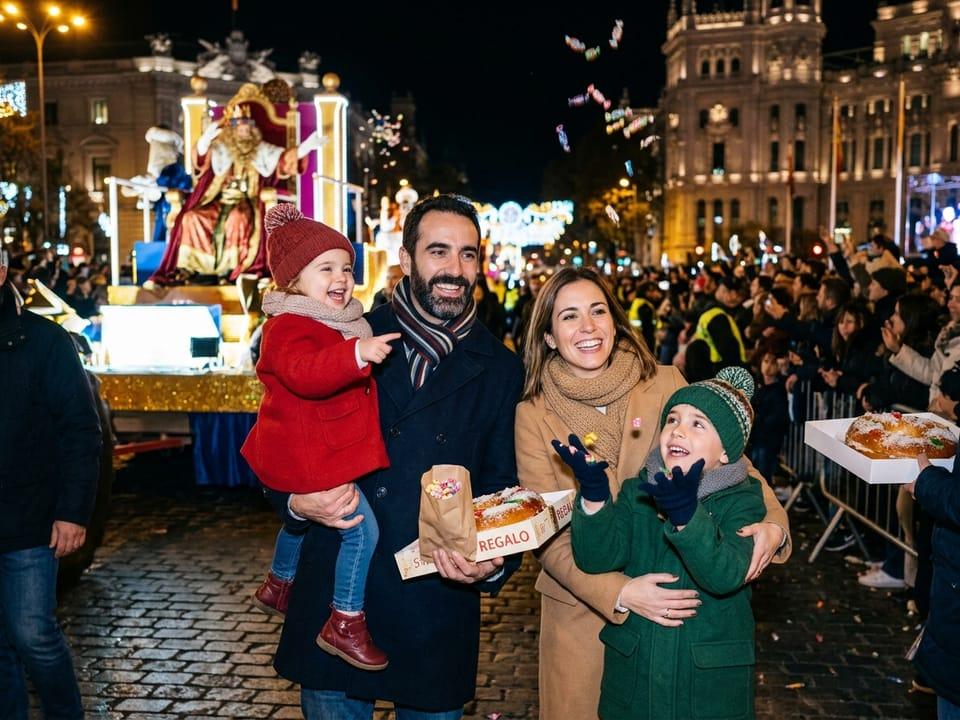
A small child crying at the sight of a bearded stranger in velvet robes on a throne is reacting to something new, loud and crowded, and the visit can still work if you change its shape. Eric Storch, a professor in Baylor College of Medicine's psychiatry department, describes children's fear of Santa Claus as mostly a response to novelty: the crowds, the noise, the queue and then sitting alone on a stranger's lap. His advice is to prepare children for what they'll see, give them choices such as standing next to the figure instead of sitting on a lap, and never force a child who is clearly terrified. With the Reyes Magos, that can mean handing over the letter while holding your hand, posting it in the royal mailbox, or watching from a few metres away, and paying for the photo only if it turns out well.
What a visit looks like in December
In the weeks before 6 January, children in Spain write a letter to Melchor, Gaspar and Baltasar asking for what they'd like, and the presents arrive on the night of the 5th. Plenty of children hand it over in person. As the Spanish Wikipedia entry on the Reyes Magos describes it, royal pages (pajes reales), or the Kings themselves, appear in shops and shopping centres, where children can sit on their knees for a photo and hand over their letter. The set usually has thrones, a star, a mailbox and pictures of camels, and a page leads each child from the waiting parents to the throne and collects the letters. Sometimes only one King appears.
Town halls also run their own events. Barcelona, for instance, invites children to send their letter, visit the Fira de Reis on the Gran Via, which ran from 18 December to 6 January last season, and see the Cabalgata on the evening of 5 January from 18:00. Whether a photo is included, sold separately or left to your own phone depends on the venue, so ask at the entrance before you queue.
Why it happens, and why it isn't a bad sign
Storch's explanation fits a royal visit closely. Children rarely see adults in long robes, crowns and big beards, the setting is usually a busy shopping centre with long queues and other children crying, and the visit ends with a stranger lifting them onto a lap. For a two- or three-year-old, that is a lot of new things at once. A child who sobbed last year has simply met all of it in one go, and there's no need to treat it as a problem to fix by next week.
What doesn't help is pressure. Telling a frightened child that the Kings won't bring presents unless they're brave turns a treat into a test. Storch's point that parents should be "empathetic and respectful" of what the child is feeling is the useful rule of thumb here.
Lower the stakes: distance, timing and a parent in the picture
Prepare at home. Look at pictures of the Kings and their pages together, talk about the throne and the beard, and let your child decide who will hold the letter. A letter in their own hands gives nervous fingers a job.
Go when the queue is short. Try opening time on a weekday rather than the last weekend before the 6th; a child who has just eaten and napped copes better than one who has waited forty minutes. Watch a few other children go first from a distance, so your child can see what happens.
At the front, offer choices rather than instructions. Your child can stand beside the King instead of sitting on his lap, sit on your lap next to the throne, give the letter to the page rather than the King, or drop it in the mailbox and wave. Each of these makes a good photo. A parent crouching beside the child, both looking at the King, can look warmer than a stiff portrait on a lap. If tears start, step aside and try once more later, or call it a day.
The venue's photo, a session or your own phone
|
Photo at the venue |
Session with a photographer |
Your own phone |
| How the cost works |
Free, included or paid, depending on the venue |
Session fee and number of files |
Only your time |
| Child's comfort |
Crowds and a stranger on a throne |
Calm, no costumed figure needed |
You choose the moment |
| Changing the date |
Come back another day, queue again |
Rebook under the photographer's terms |
Any time |
| Result |
The only shot with the King himself |
A family portrait, not a royal visit |
Candid moments, from the side |
| Suits |
Children who are curious, not scared |
Families who want a card or print |
Children who prefer distance |
The photo at the venue is the only way to get your child with a King on the throne, and that is worth something if your child is ready. If not, a family session gives you a December portrait without the costumes; our comparison of studio, outdoor and home Christmas photos covers the options. Buy the venue's print only after you've seen it.
If this year isn't the year, photograph what happens at home
Some children need another Christmas before they'll go near a throne. That's fine: the letter can go in the mailbox, the Cabalgata can be watched from a quiet corner of the route, and the morning of 6 January, when your child finds the presents, is the photo that matters most. Our guide to Three Kings' Day family photos explains how to catch it.
If you still want a picture of the whole family in a Reyes setting, pokesta can make one with AI from phone photos you already have, with no queue and no throne. It is a created image rather than a visit that happened, and it costs $1 per photo, with the first one free. Try it with a recent photo of your child before you pay for a print at the stand.
References