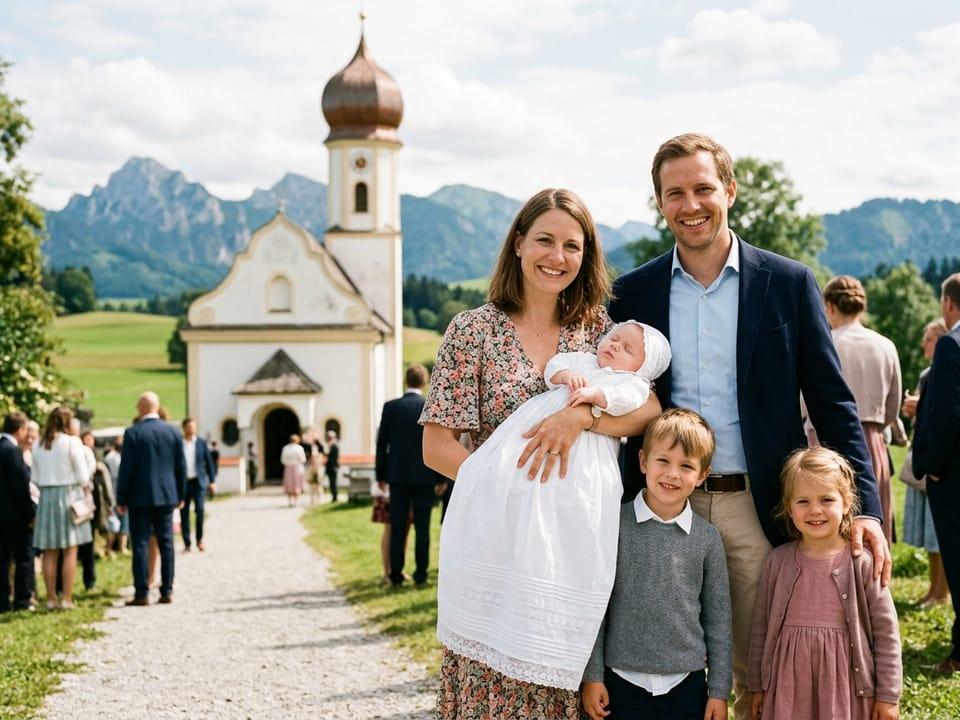
Whether you may take photos during a Taufe is decided by the person leading the service and by the rules of that church, not by the family or the photographer. Where rules are written down, they usually allow photos at the entrance, during hymns and on the way out, ask for no flash, and restrict pictures of the baptism itself. The way to get the photos you want is to agree on them in the baptism conversation, the Taufgespräch: name one person who will take pictures, and plan a second picture at the font once the service is over.
The pastor or priest decides, and many churches write it down
The Protestant church in Württemberg has a regulation on exactly this, issued by its governing council in 1985 and last amended in January 2023. Photographing, including filming, during a service needs the permission of the liturgist, the person leading it. The guiding principle is that the service and the congregation's worship must not be disturbed, and that it must not look like a show. Families asking for photos are pointed to suitable moments: the entrance, leaving the church, and congregational singing, especially the opening and closing hymns.
The same regulation says flash should only be allowed where the light really requires it. And it rules out, in principle, pictures that show the people taking part during the act of baptism itself, as well as close-ups of people praying. The liturgist can allow recording with the consent of those pictured. It also suggests what often meets families' wishes: after the baptism, the liturgist stays for a remembrance photo with the family in front of the altar or the font.
Other regional churches and Catholic parishes set their own rules, and individual congregations add details. Treat Württemberg as one well-documented example, not as the rule everywhere, and ask your own parish office.
One photographer, one fixed spot, no flash
A Protestant parish in Schwanenberg, near Erkelenz in the Rhineland, gives baptism families and couples a one-page sheet, dated January 2022, that shows what such rules look like in practice. One person chosen by the family takes the photos, and nobody else does, "not even quickly and discreetly with a smartphone". That person arrives 20 minutes before the start and goes to speak to the pastor. There's no flash or extra lighting, and shutter sounds are switched off. The photographer chooses a fixed spot with the pastor beforehand and doesn't change it during the service, picking one where they won't need to stand up.
The reasoning given is simple: the less anyone notices the photographer, the more attention stays on the service and on the family. Whatever your parish's sheet says, those habits are a safe default. A camera that clicks or flashes at the font draws every eye away from the child.
In a Sunday service, the baptism takes minutes
evangelisch.de explains that a Protestant baptism can take place within the parish's regular Sunday service or in a separate baptism service. In the Sunday service, the family is called to the font at one point, parents and godparents answer questions, the child is baptised with water and blessed, the candle is lit from the Easter candle, and everyone returns to their seats. From a fixed spot, that's a short window, and the moment with the water may be one your parish doesn't want photographed at all.
A separate baptism service gives more room. It's planned with the pastor, and you can ask which parts may be photographed and from where. Either way, if your baby is likely to be unsettled, read our guide to timing feeds and naps around the service, because a calm baby makes a short window easier.
Plan the font picture for after the service
Since the act of baptism is the moment most often restricted, plan to recreate it. After the service, gather at the font with the lit candle, the godparents and the gown, and let your photographer take their time. Ask in the Taufgespräch whether the pastor or priest will stay for a few minutes; the Württemberg regulation names exactly this as a good solution. The Württemberg rules also say the sexton, the Mesner, should be told what has been agreed, which makes sense anywhere: they're the one locking up.
Think about the other guests as well. Under section 22 of Germany's KUG, pictures of people may as a rule only be distributed or shown publicly with the consent of the person pictured. Close-ups of other guests praying are off limits in some church rules anyway; for anything you'd post online, ask first.
Studio, a hired photographer or a relative
|
Studio portrait another day |
Hired photographer |
Relative with a phone |
| Cost |
Session fee |
Hourly fee plus travel |
Nothing extra |
| Church rules |
Not affected |
Must follow them, often experienced |
Must follow them, often unaware |
| Rescheduling |
Easy |
Their calendar |
Free |
| Result |
Even light, no church |
Quiet shooting in low light |
Fine outdoors, harder inside |
| Suits |
A portrait in the gown |
The font and the big group |
Small family, short service |
A professional who knows churches will work from one spot without flash and still get usable pictures in a dim nave, which is the main thing you're paying for. A relative with a phone can do well outside and at the font afterwards, as long as they're the only one shooting. For a fuller comparison, see photographer or relative.
When the rules leave gaps in the album
If the parish allowed no photos inside and the font picture never happened, pokesta can create a baptism family photo with AI from the phone pictures each of you already has. It costs $1 per photo, and the first one is free. It's a made image rather than a record of the baptism, so try it first with one recent photo of your baby and see whether it looks right to you. Create your first Taufe family photo free.
References