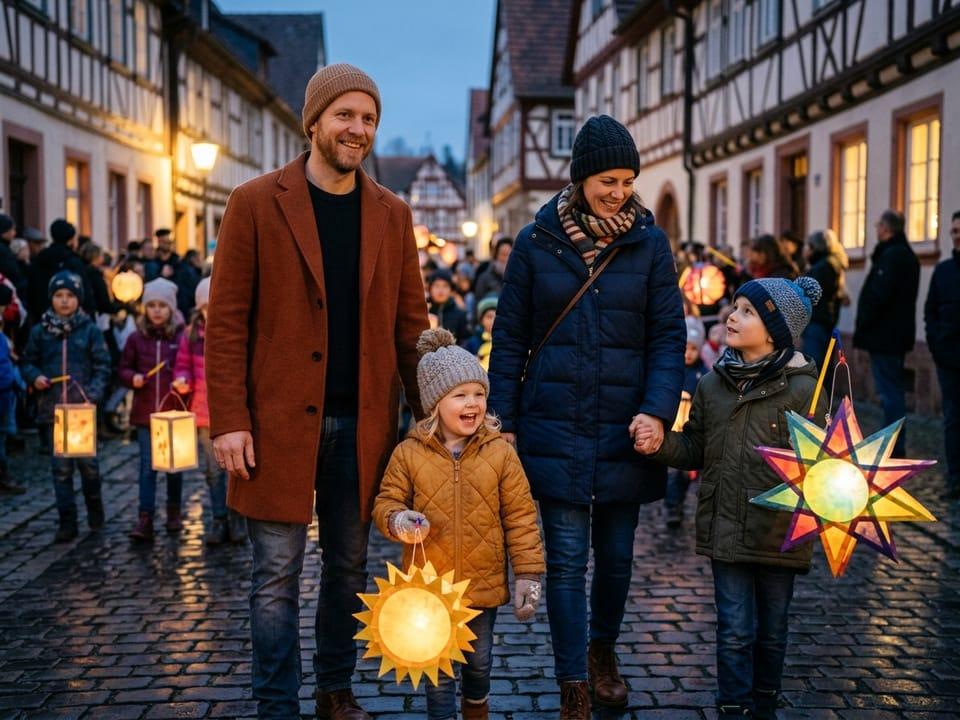
A toddler doesn't have to finish the St. Martin's lantern walk, and you don't need the walk to get the photo. Processions set off after dark, which in mid-November means late afternoon or early evening, the hour when most one- to three-year-olds are hungry and running out of patience. Move the nap, feed them before you leave, take the family picture on the doorstep while the lantern is still new, and count every step after that as a bonus.
The walk falls in a toddler's hardest hour
Krippe and Kita groups often hold their own Laternenumzug on a day around 11 November, starting once it's dark. On 11 November 2026 the sun sets at about 16:20 in Berlin, 16:41 in Munich and 16:51 in Cologne, and civil twilight ends roughly 35 minutes later. Find the meeting time in the letter from the Kita and lay it over your child's day.
That day still has a nap in it. The parents' health site kindergesundheit-info.de reports that at twelve months most children sleep twice or more during the day, that almost all 18-month-olds are down to one nap, and that 87 percent of two-year-olds and half of three-year-olds still take one. A child who went down at noon and has been awake since two arrives at the walk tired, and tired toddlers are the ones the fire and the crowd frighten.
Move the nap, feed early, dress for the cold
On the day, try starting the afternoon nap an hour later than usual, so your child wakes not long before you leave. Give a proper early dinner, something they reliably eat, before you head out. The Weckmann or the biscuits handed round at the end come far too late for an empty stomach.
November evenings are cold. The German weather service DWD puts the national November average for 1991 to 2020 at 4.8 °C, and that figure includes the warmer hours of the day; November 2025 brought a spell of hard frost early in the last third of the month. Layers under the jacket matter more than a thick coat that stops small arms bending round a lantern stick. The hat and gloves are what will show in the pictures, because the lantern lights the face and hands. A red hat glows next to an orange lantern; cream or grey stays quiet and keeps the eye on the face.
Lanterns used to be lit with candles and now often carry an electric lamp. For a toddler, a battery lantern stick means no flame inside the paper, nothing to panic about when it tips or drops, and no need to snatch it back. It gives a whiter light than a candle, which you'll see in the photos.
The horse and the fire: watch from the edge, at your height
Many processions are accompanied by a rider playing St. Martin on a white horse, and a large Martinsfeuer often ends the evening. To a two-year-old both are big, loud and suddenly close. Stand at the side of the group rather than the front and carry your child on your hip, so they see the horse from your eye level and can turn their face into your shoulder. Tell them in the afternoon what's coming: a horse, a man in a red cloak, songs, a big fire.
At the fire, stay back where the heat isn't on their face, and go when they start pulling away. If the horse makes them cry, don't carry them closer for a picture. A toddler watching from your arms with a lantern in their fist says more about this age than a close-up of the horse.
Leaving halfway is fine, because the photo already exists
The family picture belongs at the front door before you set off: lantern lit, child rested, the last blue still in the sky. That's when the lantern looks new and nobody has cried yet. For phone settings in the dark, see our guide to photographing the lantern walk.
Then take the walk as it comes. Crying that doesn't settle after a few minutes away from the group, cold hands, or eyes closing in the carrier are reasons to say goodbye to the teacher and head home. Walking back past lit windows with the lantern still glowing is a small procession of its own.
Studio, hired photographer or your own phone
|
Studio session with the lantern |
Photographer at the walk |
Your phone at home |
| Cost |
Session fee on a separate day |
Evening fee for shooting in the dark |
Nothing extra |
| Toddler's mood and health |
Daytime, warm, breaks possible |
Same tiredness as the walk |
Before the tired hour |
| Changing the date |
Rebook the slot |
Tied to the Kita's date |
Any evening that week |
| Result |
Even light, lantern as a prop |
Real procession, dark and moving |
Real lantern, your own door |
| Suits |
A printed portrait for the wall |
Big parish walks where organisers allow it |
Most families with under-threes |
A studio is worth it if you want an even, printable portrait of the lantern year, and a daytime slot never collides with bedtime. Paying a photographer to follow a Kita walk rarely is: it's dark, the children keep moving, and other families' children are in every frame. Under section 22 of the KUG, pictures of people may as a rule only be shared or shown publicly with the consent of those pictured, so ask the Kita before anyone brings a professional. For most families with a child under three, the doorstep picture on your own phone is the one that lasts.
If the walk ends early, the picture doesn't have to
Sometimes the toddler falls asleep before the lantern is lit, or the walk is rained off. pokesta can create a St. Martin family picture with AI from the phone photos each of you already has, at $1 per photo, with the first one free. It's a made image rather than a record of the evening, so start with a recent photo of your child and check that the result really looks like them. Try your first St. Martin family photo for free.
References