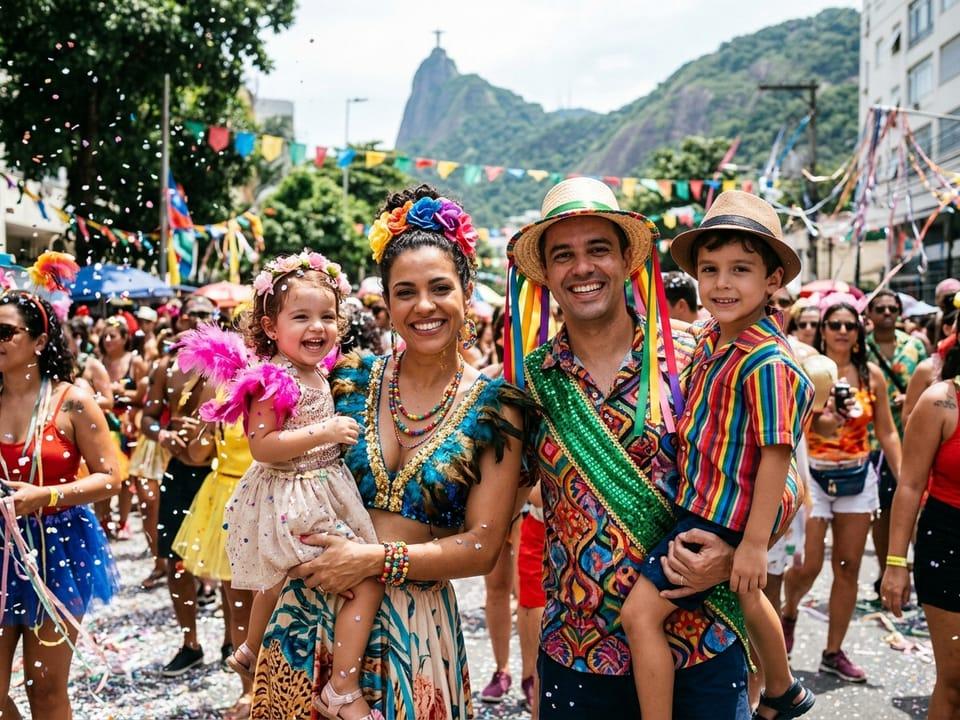
Kids' Carnival Costumes on a Budget: Improvised Fantasias That Survive the Heat and Look Good in Photos
pokesta Editorial Team · Updated November 2, 2026
The cheapest kids' carnival costume that also survives a Brazilian February starts with cotton clothes your child already wears. Colour and one or two props, such as a hat, a paper crown, a feather boa or a few stickers, carry the character, while a full-body polyester costume is often the first thing a hot child wants off. Take the photo at home, in good light, before you leave for the bailinho or the bloco, because that is when the fantasia looks its best.
Carnival 2027 lands in the hottest weeks of the year
Carnival moves with Easter. It ends at midday on Ash Wednesday, which in 2027 falls on February 10, so the festivities run from the evening of Friday, February 5. School bailinhos (children's carnival dances), club matinês and blocos infantis, the street groups for small children, tend to cluster around those dates, and the school calendar is the first place to look.
That puts the party in the middle of summer. The 1991–2020 climate normals from INMET, Brazil's national meteorological institute, give an average February maximum of 29.0°C in São Paulo, 29.1°C in Belo Horizonte, 30.5°C in Porto Alegre and 31.0°C in Recife. Those are averages, so plenty of days run hotter. A ready-made costume is often polyester, lined, closed at the neck and sold with a mask or hood. On a small child in that heat it traps sweat within minutes. It also tends to fit for a single season, so you pay full price for one afternoon of wear.
Start from the cotton clothes the child already wears
Open the wardrobe before you open a shopping app. A plain T-shirt and shorts in one strong colour make the base for most characters, and cotton breathes far better than shiny synthetic fabric. A few combinations that need very little:
Yellow T-shirt with stripes of black fabric tape and a headband with pipe-cleaner antennae: a bee.
Striped top, white shorts and a folded paper hat: a marinheiro (sailor).
A superhero's colours on a T-shirt, plus a cape cut from an old pillowcase, without the mask.
Green clothes with paper leaves pinned on: a plant, a frog or a dinosaur, depending on the hat.
For babies, a one-colour bodysuit and a soft headband with ears, and nothing on the face.
Keep the outfit loose and leave the neck and arms free. If the child will spend hours outdoors, build a cap or a brimmed hat into the character instead of a wig, and it doubles as shade.
Spend on props you can reuse, and on makeup made for children
The budget logic is simple: put the money into pieces that work for several characters and several years. A bright hat, a feather boa, a crown, a pair of wings and a sheet of stickers can be combined differently every February, and siblings or school friends can swap them. Instead of buying a new licensed costume each year, you spread the cost over several carnivals.
Face paint deserves care. Anvisa, Brazil's health regulator, explains that makeup made for children must come off easily with water, which is why it has low fixation, that parents should supervise its use and check that the product is indicated for children, and that products made for dolls must not be used on children. Keep loose glitter well away from the eyes. For a toddler, a sparkly sticker on the cheek reads the same way in photos and comes off without a fight.
Leave caricatures of real people out of the costume box
Some old carnival standards are now openly questioned. In 2018 the Indigenous artist and activist Katú Mirim launched the campaign "Índio não é fantasia" (Indigenous people are not a costume), arguing that headdresses and body paint worn for fun reinforce stereotypes. In 2020 Belo Horizonte's municipal council for racial equality criticised blackface and "nega maluca" wigs, saying blackface carries the symbolism of apartheid and should not be mistaken for homage. Opinions in Brazil still differ. For a child's photo that will be kept for years and probably shared, it is simply easier to pick an animal, a job, a fruit or a storybook character than a people.
Studio, photographer or your phone: what a carnival picture costs
You can book a themed session, but for a home-made costume the photo at home often wins. Here is how the three options compare:
Studio session
Photographer at a bloco or park
Your own phone at home
How you pay
Session fee plus extra photos
Hourly rate or package
Nothing extra
Heat and mood
Air-conditioned, but a fixed slot
Sun and crowds
You choose the moment
Changing the date
Depends on the studio's rules
Depends on the photographer's rules
Any time
Result
Even light, edited files
The real carnival atmosphere
Depends on light and patience
Suits
Families who want a framed print
Families who want the day itself recorded
Most families with small children
A professional earns the fee when you want the day itself on record: a school presentation, a big family group at a bloco, or a child old enough to enjoy posing. For a two-year-old in a home-made bee costume, ten minutes by a bright window in the morning, with the phone at the child's eye level, gives you better odds. Shoot before you leave, while the hat is still straight and the face paint fresh. At the bloco, take a few quick frames and then just enjoy it; our guide to taking small children to a bloquinho covers heat and crowds.
When the costume photo didn't happen
Some years the child runs a fever on the day, refuses the hat, or the bailinho is called off. If you still want a carnival picture with the whole family in it, pokesta can build one with AI from the phone photos you already have of each person, for $1 per photo, and the first photo is free. It is a made image rather than a record of the day, so keep it next to the real snapshots. Start with one recent photo of your child and try it free before buying anything for next year, and see what other families made on the carnival page.